Customer expectations in 2026 are higher than ever. People want instant replies, personalized support, and 24/7 availability — whether they’re ordering a product, renewing a subscription, or asking for technical help.
For large enterprises, meeting these demands usually means hiring bigger teams and investing in complex systems. But for small and mid-sized businesses (SMBs), the situation is very different.
They face a tough question:
Do we keep hiring more people, or do we automate smarter?
Let’s explore the reality SMBs face and how they can keep up without burning out their teams or budgets.
The Customer Expectation Gap
Modern customers expect:
- Replies within minutes, not hours
- Support across email, chat, and social media
- Accurate answers on the first interaction
- Consistent service — even outside business hours
But most SMBs operate with small teams wearing multiple hats. The same person handling customer queries may also be managing billing, marketing, or operations.
This creates a growing expectation gap — what customers want vs. what small teams can realistically deliver.
Why Hiring Alone Isn’t the Perfect Solution
When support requests increase, the natural instinct is to hire.
While hiring works, it comes with serious challenges for SMBs:
1️⃣ Rising Costs
Recruiting, salaries, training, and tools add up quickly. For many SMBs, hiring even one extra team member is a major financial commitment.
2️⃣ Training Time
New hires don’t become productive instantly. They need time to understand products, workflows, and internal systems.
3️⃣ Inconsistent Service
Different agents may provide different answers unless processes are tightly documented — something many small businesses struggle with.
4️⃣ Scaling Becomes Hard
As the business grows, so does the support load. Hiring linearly with growth is rarely sustainable.
Hiring is important — but relying only on people to handle every repetitive task can slow a business down.
The Hidden Problem: Repetitive Operational Work
Here’s what really eats up time in small teams:
- Resetting passwords
- Sending invoice copies
- Answering “Where is my order?”
- Sharing onboarding steps
- Updating tickets or CRM records
- Routing customer issues to the right department
These are essential tasks, but they’re repetitive, rule-based, and time-consuming. When humans spend hours doing this every day, they have less time for complex, high-value interactions.
Example: A Small Web Hosting Company
Let’s take a typical SMB example — a growing web hosting provider.
Every day, their support inbox is filled with:
- “How do I connect my domain?”
- “Why is my website slow?”
- “Can you resend my invoice?”
- “How do I upgrade my plan?”
- “My email isn’t working”
Many of these questions have standard, repeatable answers based on documentation and internal workflows.
But if every ticket requires a human to read, respond, log details, and escalate manually, the team quickly becomes overwhelmed — especially during peak times.
The result?
- Slower response times
- Frustrated customers
- Burned-out staff
- Missed growth opportunities
Where Automation Changes the Game
This is where smart automation steps in — not to replace people, but to support them.
Automation can:
✔ Instantly respond to common questions
✔ Pull answers from knowledge bases or help centers
✔ Trigger workflows like ticket creation or routing
✔ Collect required information before a human steps in
✔ Operate 24/7 without increasing payroll
Instead of hiring just to keep up with repetitive demand, SMBs can automate the operational layer and let their team focus on meaningful conversations.
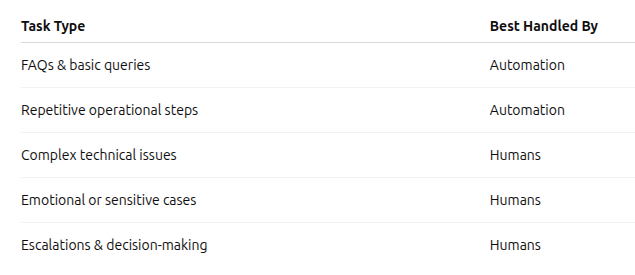
Human + AI: A Smarter Support Model
The most effective model for SMBs isn’t “humans vs. automation.”
It’s humans supported by automation.
How AI Helps With Repetitive Workflows
Modern AI tools go beyond just chat responses. They can be trained on your existing documentation, workflows, and internal processes to:
- Guide customers step-by-step
- Collect issue details automatically
- Route requests to the right team
- Trigger backend actions
This is especially powerful for SMBs that already have help articles, SOPs, or internal guides — but don’t have the bandwidth to manually apply them to every ticket.
Solutions like PagerGPT are designed with this exact challenge in mind. Instead of adding complexity, they help small businesses automate repetitive operational workflows using their existing knowledge resources — reducing workload without losing service quality.
Sign Up for PagerGPT Free Trial
The Real Benefit: Breathing Room for Your Team
When repetitive requests are handled automatically:
- Response times improve
- Customers get help faster
- Support staff can focus on complex, high-impact issues
- Stress levels drop
- The business can scale without immediately scaling headcount
Automation doesn’t remove the human touch — it protects it by freeing humans from routine tasks.
So, Hiring or Automation?
For SMBs, the smartest answer is:
Automate first. Hire for what automation can’t do.
Use automation to handle volume and repetition. Hire people for empathy, expertise, and problem-solving.
That’s how small businesses can meet rising customer expectations — not by trying to outgrow their resources, but by working smarter with the right support systems in place.

 Content Writing Agency in Delhi