
Author: Chandana V | SterlingNext
An AI agent suggested that the cache setting on the website be changed, as it was observing that it was running slowly. However, when the developer was about to implement the change, they noticed that the said setting was applied to checkout and campaign pages. This means that implementing the change would have resulted in customers not being able to make purchases and the company not being able to collect the money.
Learn more: AI Write for Us
ITIL change enablement processes allow change managers to delegate, analyze possible outcomes, and plan recovery processes prior to making the change. Tools that enable faster change cycles reduce the delay between suggestion and outcome. Teams should establish governance processes and procedures, automated changes, and changes requiring analysis. Additionally, there should also be processes that will halt the change if specific criteria are not met.
What Change Enablement Means for Modern IT Teams
Change enablement enables the team to review a change, obtain the approvals needed, and identify when to implement the change. This can reduce the risk of incidents occurring as a result of changes to a service. Change enablement works alongside other ITIL service management practices, including incident management and continual improvement.
A website update needs more than a completed development task. Someone must check affected services, approve the work through the appropriate process, and confirm that the result meets expectations.
This differs from helping employees adopt new software, which involves training, communication, and adjustments to working habits.
Standard changes in ITIL are low risk, well-documented, well-understood, and pre-approved. The approval includes the specific procedure and its criteria. A routine change on a test site does not automatically qualify for the same approval on a payment service.
Learn more: Write for Us + Technology
Why AI and Automation Raise the Stakes
A wrong manual change may cause trouble in one service. With automation, the same mistake can spread to several services before it is found.
Faster Changes Can Spread Problems Further
IT change management automation can reduce implementation time, but it can repeat the same error in all selected targets. The term “blast radius” refers to the potential impact area. For a marketing team, this can mean that due to an incorrectly implemented configuration change request, all the forms on several pages of marketing campaigns will stop working. It is necessary to limit the scope of a change to ensure that one erroneous code does not affect all website areas.
AI Can Influence Both Decisions and Execution
AI IT Change Management can make use of AI to summarize records or suggest remedies. Fixed automation relies on predetermined rules, while agentic AI IT operations have the capacity to choose tools and actions based on instructions and observations.
DORA’s 2025 research found that AI can amplify existing organizational strengths and weaknesses. Teams should examine the procedures around the tool as carefully as the recommendations it produces.
Decide What Can Run Automatically and What Needs Review
A risk assessment of the change should identify services affected by the change, the areas of uncertainty, the permissions needed, and the options for recovery. The approval process for a risk-based change should evaluate the risk findings. Approving changes to a test page should not require the same level of review as changes involving customer records.
| Proposed Change | Review and Authorization |
| A proven task within its approved scope | Follow the preauthorized procedure, check its conditions, and record the outcome. |
| A new prompt or model affecting operational decisions | Test changed behavior and obtain authorization from the responsible authority. |
| An agent receives production write access | Assess permissions, service dependencies, and recovery arrangements before approval. |
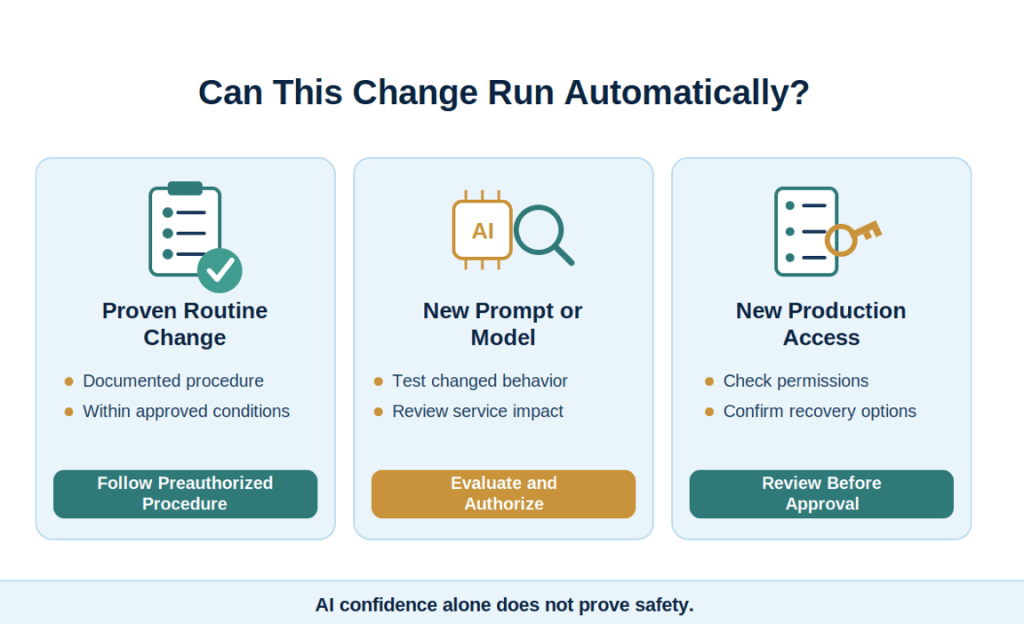
A high AI confidence score does not show that a change is safe. The proposal may omit a shared database or rely on outdated service records.
Human in the AI loop requires the reviewer to be able to question the recommendation. The reviewer needs the list of impacted services, test results, desired outcome, and recovery instructions.
Urgent changes still require an authority and records. ITIL change enablement allows groups to create an emergency pathway while keeping the approval responsibilities clear.
Include Prompts, Models, and Permissions in Change Reviews
Application code can stay unchanged while an agent starts behaving Application code may remain static while the agent starts to act differently. A refined prompt might increase the frequency with which it resets itself. An update to the model may cause it to recommend different actions based on the same alert.
AI model change management should include the settings and connections that influence those decisions:
- Instructions, prompts, and model versions.
- Data sources and tools available to the agent.
- Permissions to modify live services.
Record the version, expected behavior, evaluation results, and responsible owner. Keep failed test results alongside successful ones so reviewers can see the conditions that caused trouble.
AI governance in IT needs named people responsible for operational decisions. Bring updates into the organization’s change process according to their service impact. Repeat the change risk assessment when new permissions, information, or behavior make the earlier authorization unsuitable.
Apply the Process to an Automated Remediation Example
Hypothetical example: An agent informs about a malfunctioning service that is available on a campaign page and recommends restarting the service. The team allows the system to restart the service under specific conditions.
Establish the Operating Limits
Assign someone to manage the service and list the instances the agent can restart. Before the restart, check that another instance can handle the traffic and the related services are working.
First, let the agent suggest possible actions for an operator to consider. Allow actions to be taken only under verified, approved conditions. The failure of any check or the presence of an unexpected target should require human intervention.
Test on a Limited Scope
Test instances where restarting is appropriate and not (e.g., slow database). Initiate a single instance during the agreed period of monitoring.
Compare error messages, response times, and successful submissions of the form before and after running. Running the process does not confirm that a visitor can submit a question.
Define When to Stop and How to Recover
Prior to allowing execution, decide on intervention criteria. Identify the operator who gets alerts and the person in charge of restoring service in the event that the restart results in additional issues.
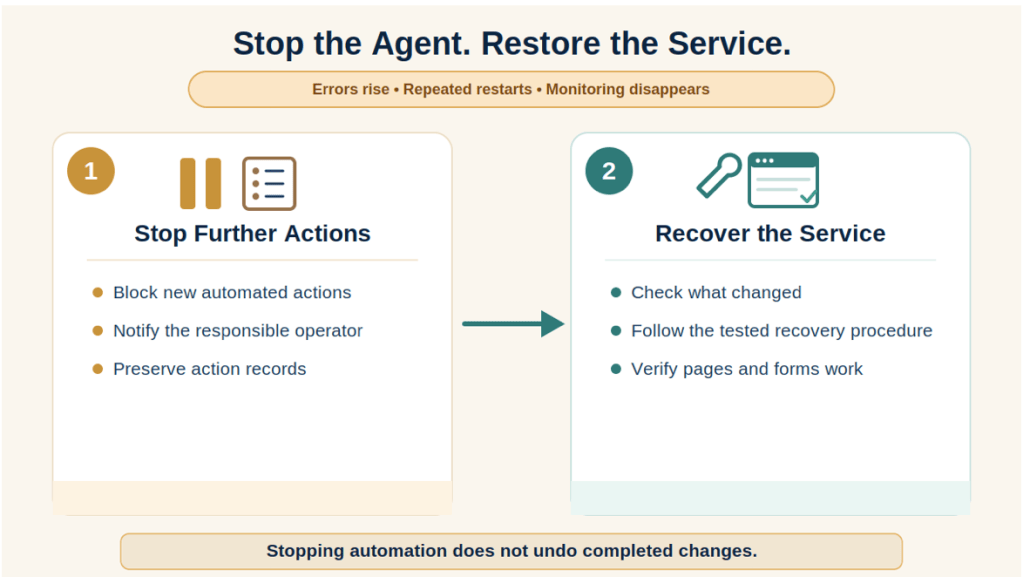
Stop Further Actions
Stop performing any further actions in case there are issues that worsen, data to monitor goes away, or the agent continually asks to restart. Provide the operator with the action history and the target that was affected.
Restore the Affected Service
A change rollback plan should differentiate between changes that can be reversed and those that have already occurred. The system restart cannot repair failed requests. In this case, the recovery strategy may involve rerouting traffic, reversion of the system to a previous state, or problem resolution.
The agent’s termination cannot remedy the situation; therefore, it is necessary to save its proposals, supporting evidence, authorization, actions, and results for the operator’s reference.
Measure Whether Automation Improves Service Outcomes
Assess AI in IT service management against service performance. Completing more tasks is useful only if the team understands whether those tasks also introduce failures.
Track four measures:
- Change lead time: The period that commences at an established first point and ends at the point of implementation.
- Change failure rate: The percentage of changes that result in a service incident or require improvement.
- Recovery time: It is the time taken before services start operating after a failed change.
- Unauthorized actions: These are unauthorized activities carried out or planned.
Compare similar types of changes before and after automation. Include the number of changes behind each percentage. A lower change failure rate among a few simple tasks does not establish that more complex changes are safe.
Check the business functions, and make sure that the forms are capturing the leads, the analytics is tracking the events, and the published pages are still accessible. This will reveal the problems that are not apparent from the simple server health tests.
Reviewers need enough context to understand why a recommendation should be rejected. Operators need to practice bringing the system down to test their response before doing it for real.
Conclusion
Each automated action requires an owner, approved scope, and recovery procedure that has been tested by someone. ITIL change enablement assists in establishing such requirements for change before escalating the number of changes. It is necessary to begin with one recurring activity, determine where it can be automated, identify the conditions under which changes should be implemented, and test recovery. It is essential to ensure the result of this trial with the service owner before expanding the automation to other processes and targets. In addition, instructions and contact information must always be available to the personnel who will perform the necessary operations in case of a failure.


